
Stop Calling It Being a Good Person
The fourth threat response nobody warned you about


You leave the conversation.
You replay it on the drive home.
Why did I just agree to that?
Welcome to fawning. It’s the one nobody warned you about.
It looks like being a good person
From the outside, this pattern is lovely. You’re flexible. Diplomatic. The one who reads the room and adjusts. The one who remembers everyone’s preferences and smooths things over.
People love you for it. You might even love yourself for it.
But underneath? You’re swallowing the “no” before it fully forms. You’re managing everyone else’s inner world while quietly abandoning your own. And your body is keeping the tab.
The tightness in your shoulders. The queasiness in your stomach. The headaches that show up after family dinners. All those repressed feelings have to go somewhere.
Fawning is not the same as people-pleasing
These get used like synonyms, and they’re not.
People-pleasing is the behavior. Fawning is a nervous system state underneath some of it.
People-pleasing is broader. Sometimes it’s how you were raised. Sometimes it’s situational. You want the promotion, so you’re agreeable at work. You like being the helpful one.
A lot of people-pleasing is conscious. You know you’re doing it. You could, in theory, choose differently.
Fawning is something else. It’s your body going into survival mode.
This was coined by a therapist who described the survival pattern he kept seeing in clients who grew up with relational threat, usually a parent who was unpredictable, critical, or unsafe.
Fawn is the quietest. It doesn’t look like fear. It looks like friendliness.
Your nervous system has decided, in less than a second, that the fastest way to safety is to make them comfortable. Agree. Soothe. Get small.
This happens before your thinking brain gets a vote. By the time you notice, you’re three sentences into yes.
How to tell which one you’re doing
Ask yourself a few questions.
Did you know you were doing it? People-pleasing tends to be visible to you in the moment. Fawning is faster than thought.
What did your body do? People-pleasing feels like a worn-out choice. Fawning comes with the bracing, the held breath, the stomach drop you only notice afterward.
How do you feel after? People-pleasing leaves you mildly annoyed with yourself. Fawning leaves you a little ashamed and drained in a way that doesn’t match what just happened.
The two also overlap. A lot of what gets called people-pleasing has fawn underneath it.
The old story running the show
Underneath the fawn, there’s usually a story. Something like:
If I disappoint them, I’ll lose them.
If I push back, it’ll get worse.
My feelings are too much. Theirs matter more.
These aren’t conscious thoughts you’re choosing now. They’re conclusions you drew a long time ago, probably before you had words for them.
A girl watching her mother’s mood shift and learning to manage it. A teenager realizing that having needs made her a burden. A young woman figuring out that agreeable women get loved and difficult ones do not.
You learned. You adapted. That learning stuck.
That younger version of you read the room and found a way to belong.
The thing is, she never got the memo that the danger had passed.
The moment before
There’s a flicker right before you fawn. A flash of hmm, I don’t actually want to do this. A tiny internal flinch. A half-second where your real answer is still available.
Then the old pattern kicks in, and you’re already saying, “Sure, no problem!”
That flicker is your actual self, trying to get a word in. She’s been there the whole time.
Why willpower won’t fix this
If it’s people-pleasing, you can often work with it through practice and getting more comfortable disappointing someone.
If it’s fawning, that approach won’t hold. You can’t logic your way out of a nervous system response.
You have to work with your body. You have to help the part of you that’s still braced for an old danger feel, at a gut level, that the danger is over.
That’s slower work. Gentler. Less about forcing a “no” out of your mouth, more about creating enough safety inside you that the “no” can come up on its own.
The cost
Self-abandonment doesn't stay in your head. It moves into your body.
In the resentment that sneaks in after the dinner you didn’t want to host.
In the quiet grief of realizing you don’t actually know what you want anymore, because you’ve spent so long tracking what everyone else needs.
Your body has been telling you. It’s just been speaking a language you weren’t taught to read.
She kept you safe
She kept you connected. She kept you safe enough to get here.
We’re not getting rid of her.
We’re updating her.
Showing her that you’re grown now.
That you can handle a hard conversation.
That the old rules don’t apply the way they used to.
She kept you small enough to be safe.
You don't have to stay small anymore.
One more thing, before you go
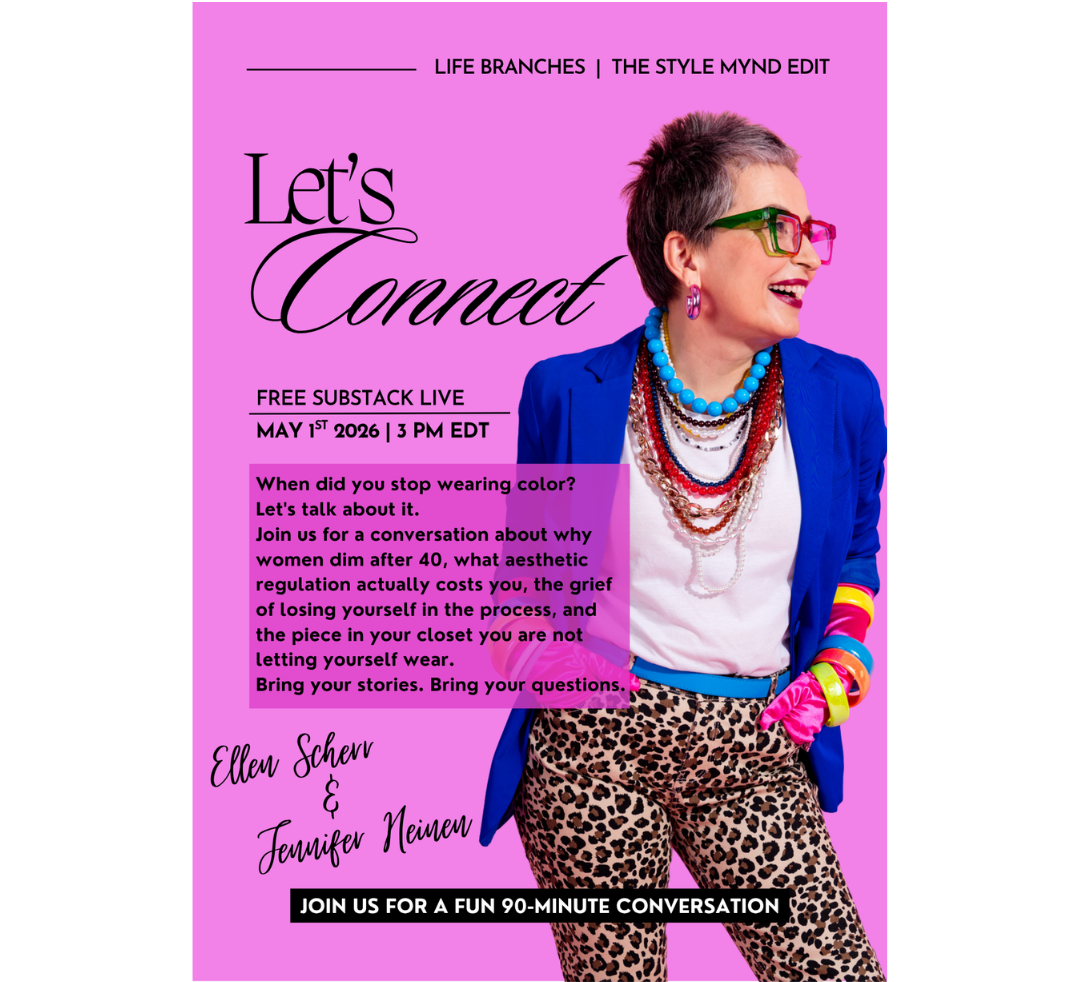
I’m co-hosting a free Substack Live with Jennifer Heinen of The Style Mynd Edit on May 1st at 3pm EDT. The conversation is called “Invisible After 40: Let’s Talk About It.”
When did you stop wearing color? When did you start reaching for the beige cardigan instead of the one you actually love? What’s the piece in your closet you keep telling yourself is “too much”?
It’s 90 minutes. It’s free. It’s going to be fun.
Come hang out with us on Friday.
Wear the bracelet you’ve been afraid to wear.
I didn’t need to read beyond the title - I knew what you were going to say. I did read, though. It is helpful to be working with a therapist because the older you are, the harder it is to recognize it.
The physical feelings you described are so precisely identical to what I’ve experienced with fawning that I couldn’t believe it 🤯