

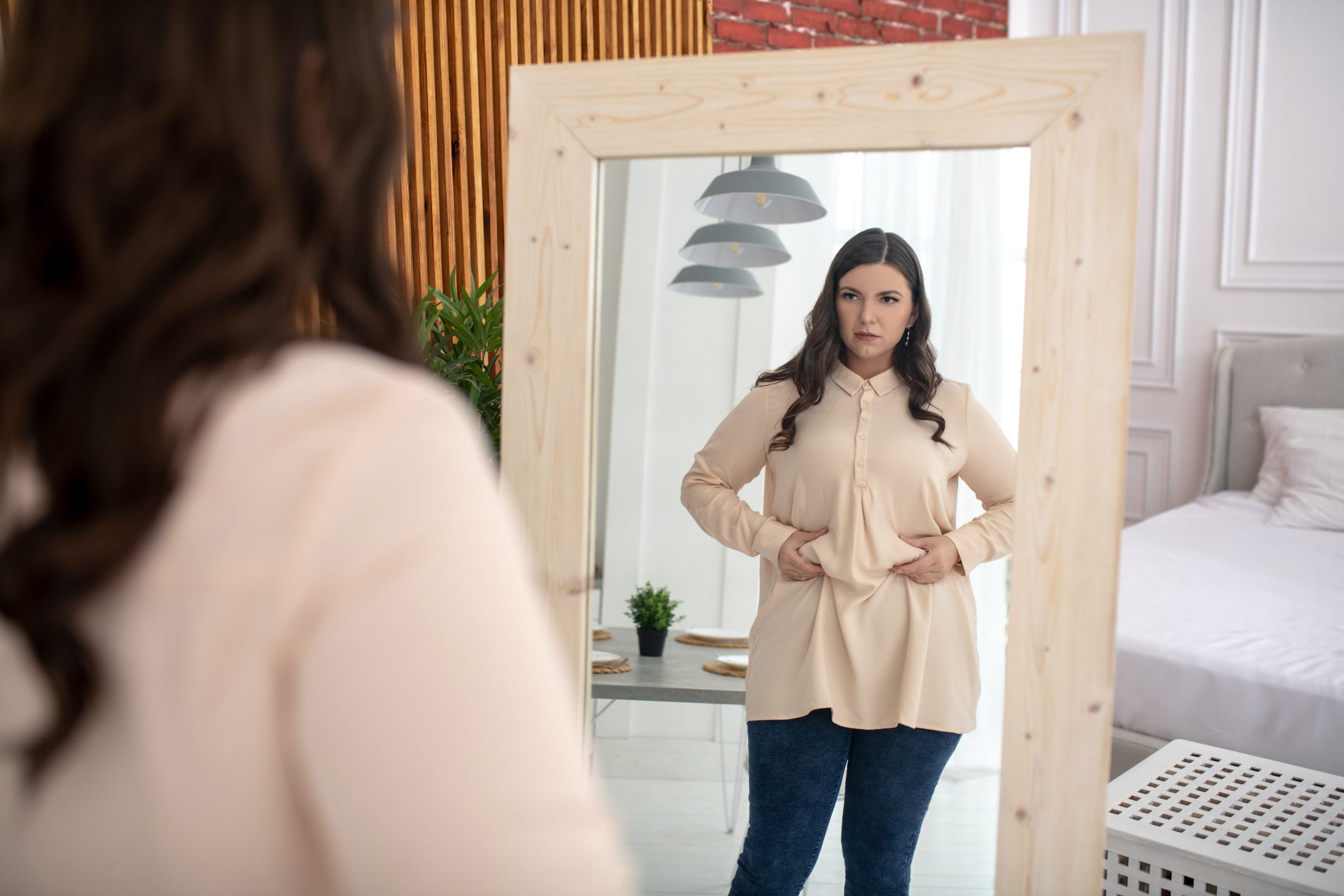
I stood in my closet last Tuesday staring at a pair of jeans I haven’t been able to zip in three years. They’re still hanging there. Taking up space. A denim monument to a body that doesn’t exist anymore.
You probably have your own version of these jeans.
Maybe it’s that dress from the wedding in 2019. Or the blazer that fit when you got promoted. Whatever it is, you keep it because some part of you thinks if you just try hard enough, restrict enough, move enough, you’ll earn that body back.
Here’s the thing nobody tells you: You’re not crazy for feeling this way.
You’re grieving.
And grief, even grief over something as “superficial” as a changing waistline,deserves to be acknowledged. Not dismissed with some Pinterest quote about loving your curves.
The grief nobody talks about
We live in a culture that’s comfortable with two extremes when it comes to body changes.
On one end, there’s the diet industrial complex telling you your changing body is a problem to be solved. A failure to be corrected. They’ve got a supplement for that. A program. A 21-day fix.
On the other end, there’s toxic positivity dressed up as body acceptance. You should love every stretch mark. Celebrate every roll. Find your new softness beautiful. As if you can affirm your way out of actual loss.
Both approaches miss what’s actually happening.
You’re mourning a version of yourself that existed in a different time. Under different circumstances. In a different body. And that mourning is legitimate.
The body you had at 25? It’s not coming back. No matter how many green smoothies you drink. The body you had before kids, before perimenopause, before the medication that saved your mental health but changed your metabolism—that body is gone.
And it’s okay to be sad about that.
What we’re really mourning
Here’s what I’ve noticed in 15+ years of sitting with women through major life transitions: The grief about body changes is almost never actually about the body.
It’s about what that body represented.
When you mourn your “before” body, you might actually be mourning:
The effortlessness. Remember when you could eat pizza at midnight and wake up feeling fine? When you didn’t think about whether restaurant chairs had arms? When you could buy clothes without wondering if they came in your size? That ease is what you’re missing.
The identity. You were “the athletic one” or “the one who could eat anything” or “the girl with the great butt.” Your body was part of how you understood yourself. When it changes, you have to rebuild your sense of who you are. That’s exhausting.
The invincibility. Your body changing is proof that time is passing. That you’re aging. That you’re mortal. That’s heavy to carry while you’re just trying to find pants that fit.
The control. In a world that feels chaotic, your body was one thing you could manage. Perfect. Except now it’s doing its own thing despite your best efforts. And that loss of control is terrifying.
These are real losses. They deserve real grief.
Why body positivity misses the mark
The body positivity movement did important work. It challenged narrow beauty standards. Created space for diverse bodies. Pushed back against diet culture.
But somewhere along the way, it became another set of rules we’re failing to follow.
Now we’re supposed to love our cellulite. Celebrate our belly fat. Find our arm jiggle empowering. And if we don’t? If we’re still struggling with how our body has changed? Well, clearly we haven’t done enough personal growth work.
That’s just diet culture in a crop top.
Real acceptance isn’t performing gratitude for every physical change. It’s not forcing yourself to find beauty in things that genuinely distress you. It’s avoidance dressed up in self-help language.
Real acceptance is messier than that.
Body neutrality: A different approach
This is where body neutrality comes in.
Instead of demanding that you love your body or hate your body, body neutrality suggests a different option: respect it.
Respect the body that’s carrying you through middle age. Even if it’s not the body you had at 30. Respect its capacity to heal. To adapt. To keep showing up.
Body neutrality says: Your body doesn’t have to be beautiful to be worthy of care.
It acknowledges that your body is changing because bodies change. That’s not a moral failure. It’s biology. Gravity exists. Metabolism shifts. Hormones fluctuate. Cells age. None of this makes you less valuable as a human being.
Body neutrality creates space for you to feel complicated about your body. To appreciate what it does while also grieving what it no longer does. To take care of it without making that care contingent on it looking a certain way.
It’s the middle path between self-hatred and forced positivity.
The practical work of grief
So what do you actually do with this grief?
First, stop pretending it’s not there. Stop telling yourself you’re being shallow or vain. The grief is real. Name it.
Second, get honest about what you’re actually mourning. Is it the body itself, or what that body represented? What did you lose when your body changed? Write it down. Say it out loud. Let yourself feel it.
Third, consider what your body has gained. I know this sounds like toxic positivity, but hear me out. Your softer body might be evidence of medication that stabilized your mental health. Your wider hips might have delivered your children. Your slower metabolism might be paired with wisdom you didn’t have at 25. You don’t have to celebrate these trade-offs. But you can acknowledge them.
Fourth, audit your environment. Those jeans you can’t zip? They’re not motivation. They’re torture devices. Clear out the clothes that don’t fit. Unfollow the Instagram accounts that make you feel inadequate. Stop consuming content that profits from your self-hatred.
Fifth, invest in your current body. Not your fantasy body. Buy clothes that fit now. Not the size you hope to be someday. Move in ways that feel good, not as punishment. Feed yourself like someone you actually care about.
The uncomfortable truth
Your body is going to keep changing. Next year it will be different than it is today. In five years, you’ll look back at photos from now and think, “I looked pretty good there.” Even though you’re criticizing that body today.
This is the uncomfortable truth about bodies: They’re not static. They’re not meant to be preserved like museum pieces. They’re dynamic systems designed to adapt to changing circumstances.
The body you’re mourning right now? Someone in the future will mourn the body you have today.
So what if instead of waiting until you’ve changed again to appreciate where you are, you started now?
Not with forced gratitude. Not with affirmations you don’t believe. But with simple respect for the body that’s gotten you this far.
Moving forward
Here’s what I know after years of sitting with women through this transition, and going through it myself: The grief doesn’t completely disappear. Some days you’ll still feel it. When you’re shopping for clothes. When you see old photos. When you catch your reflection unexpectedly.
But the grief does get quieter. It takes up less space. It stops defining your entire relationship with your body.
And in that quiet space, something new becomes possible. Not necessarily love. But something more sustainable: acceptance.
The acceptance that this is your body now. That it’s different than it was. That it will keep changing. That this is part of being human. The acceptance that you can take care of something without requiring it to be perfect first.
Your “before” body isn’t coming back.
But your “now” body is here. Doing its best. Carrying you through your one precious life.
And that matters more than beautiful ever did.
Anyone else still holding onto clothes from two sizes ago, or is it just me?
I’m building a space for women who are done performing. If this resonated with you, stick around. There’s more where this came from, and we’re just getting started.
I am almost 77. My knees and hips hurt with arthritis but I am thankful they still work! They have carried me through childhood and skinned knees, pregnancy with added weight stress, gardening, jogging, walking dogs, countless stairs and trips from point A to B. My eyes are tricksy but as I tell the ophthalmologist ‘I can’t complain after almost 77 years of service’ - for a voracious reader from childhood, a mom watching out for her children, Our bodies are miracles of self-maintenance , regeneration, and durability. This article is an affirmation of what I feel -
I loved this post. Our bodies will age and die, no exceptions. Maybe we all need to start focusing on our spirits, rather than our bodies. Perhaps that's the whole point of aging.