

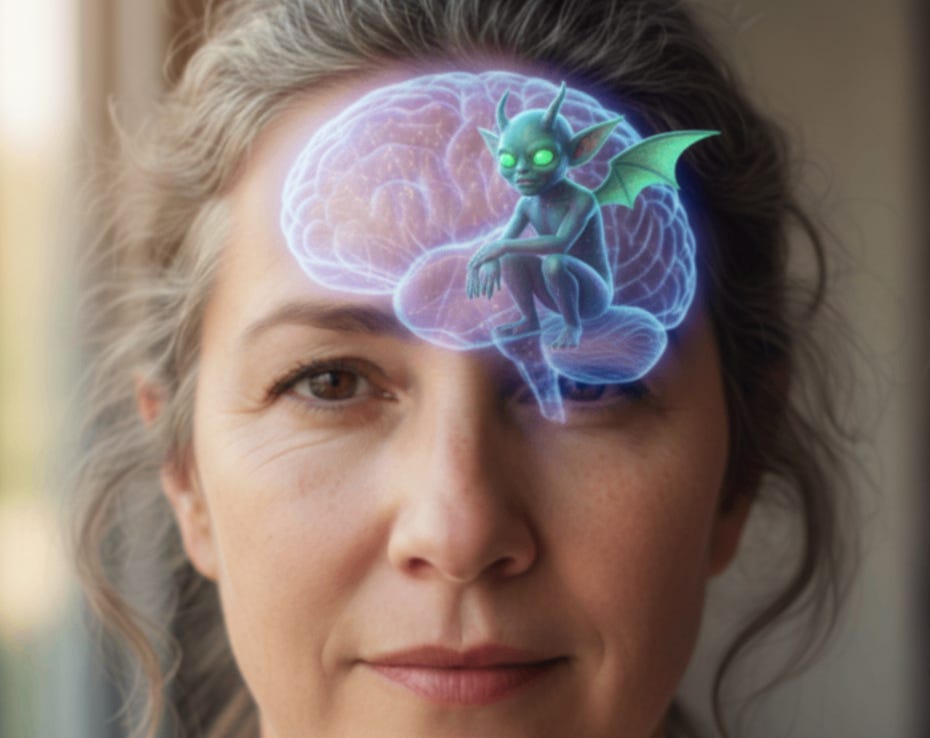
You know that voice in your head? The one that narrates your life, comments on everything, and never shuts up?
She’s been with you forever. But lately, she’s gotten mean.
Not just critical. Mean.
And if you’re in midlife, there’s a reason for that.
The voice was always there
If you have an inner monologue, you’ve had it your whole life. It’s the voice that reads these words to you right now. The one that reminds you to buy milk, rehearses conversations, replays that thing you said to an ex 20 years ago.
For most of your life, she was manageable. Sometimes helpful. Sometimes annoying. But mostly just there.
Then perimenopause hit.
And suddenly she turned into a monster.
What hormones do to your inner critic
Here’s what’s happening: estrogen and progesterone help regulate serotonin and GABA in your brain. These are the chemicals that keep your mood stable and your anxiety in check.
When those hormones start dropping, your brain chemistry shifts.
And that inner voice? She gets louder. Faster. More relentless.
The thoughts that used to be background noise become a screaming match in your head.
Before perimenopause, maybe your inner monologue sounded like mild worry. “Did I lock the door? Should I have said that differently?”
Now she sounds like this:
“You’re a complete failure. Everyone can see you’re falling apart. You’re too old. Too fat. Too much. Not enough. Why can’t you just be normal?”
This isn’t you being dramatic.
This is your brain on hormonal chaos.
But here’s the thing about your brain
Your brain is neuroplastic.
That’s just a fancy way of saying it can change. Rewire itself. Create new pathways and weaken old ones.
Every thought you think creates a neural pathway. And the more you think that thought, the stronger that pathway becomes.
Think of it like a path through the woods. The first time you walk it, you’re pushing through brush and branches. But walk it every day for a year? You’ve got a clear trail.
Your inner critic has been walking the same trail for decades. “You’re not good enough. You’re failing. You’re stuck.”
That path is a highway now.
The cognitive distortion highway
In my therapy practice, I teach people about cognitive distortions. These are the thinking patterns that fuel anxiety and depression.
During perimenopause, your inner voice becomes a cognitive distortion factory.
She catastrophizes. “This headache could be a brain tumor.”
She mind-reads. “My boss didn’t smile at me. I’m getting fired.”
She overgeneralizes. “I forgot one thing. I’m losing my mind.”
And because she’s been practicing these distortions your whole life, the neural pathways are strong. Automatic. Your brain defaults to them without even trying.
Add fluctuating hormones to the mix? Those pathways light up like Times Square.
You can build new pathways
But neuroplasticity works both ways.
If you can strengthen a pathway by repeating thoughts, you can also weaken it. And you can build new ones.
This isn’t about positive thinking or affirmations. This is actual neuroscience.
When you catch a cognitive distortion and challenge it, you’re interrupting that old pathway. And when you replace it with a more accurate thought, you’re starting to build a new one.
Do it once? Nothing changes.
Do it a hundred times? A thousand? You’re literally rewiring your brain.
Naming it
There’s a saying in psychology: Name it to tame it.
When you can identify what your brain is doing, you take away some of its power.
“I’m catastrophizing right now.” “That’s all-or-nothing thinking.” “My brain is mind-reading again.”
Just naming the distortion creates distance between you and the thought. It shifts you from “I’m a failure” to “My brain is telling me I’m a failure.” That’s a cognitive distortion.
Sounds simple. But it’s neuroscience.
When you name what’s happening, you activate the prefrontal cortex—the part of your brain that thinks rationally. That interrupts the amygdala, which is where all the emotional panic lives.
You’re literally using one part of your brain to calm down another part.
And during perimenopause, when your emotional regulation is already compromised, this skill becomes essential.
Because you can’t challenge a thought you haven’t identified. And you can’t build a new neural pathway if you’re still unconsciously running down the old one.
Name it first. Then you can tame it.
Enter Dolores
So that’s what I did. Meet Dolores.
She’s the name I created to interrupt the toxic inner monologue. To build those new pathways.
When my inner voice starts catastrophizing at 2am, Dolores steps in.
Inner voice: “You’re a terrible mother and everyone knows it.”
Dolores: “Based on what? That you got frustrated yesterday? You’re human. That doesn’t make you terrible.”
Every time I do this, I’m weakening the old pathway and strengthening a new one.
How to train your brain
First, you have to catch the distortion as soon as it happens.
That’s the hard part. Your inner narrator is fast. Milliseconds fast. And during perimenopause, when your emotional regulation is shot, those thoughts feel like absolute truth.
But the more you practice catching them, the better you get at it.
Second, you challenge the thought. Is it actually true? What’s the evidence? What would I tell a friend who said this about herself?
Third, you replace it with something more accurate. Not fake positive. Just less distorted.
“I’m a complete failure” becomes “I’m struggling right now because my hormones are making everything harder.”
“Everyone thinks I’m incompetent” becomes “I don’t actually know what anyone else is thinking. And one mistake doesn’t define me.”
It takes time
Here’s what I tell my therapy clients: the neural pathways you’ve been using for 40+ years aren’t going to disappear overnight.
Your inner critic has had decades of practice. She’s got a superhighway.
The new pathways you’re building? They’re dirt trails right now.
But every time you catch a distortion and challenge it, you’re making that new trail a little clearer. A little easier to find next time.
And every time you don’t engage with the old thought, that highway gets a little less traveled.
Your brain during menopause
The hormonal chaos of perimenopause makes this work harder.
Your brain chemistry is unreliable. Your emotional regulation is compromised. The inner voice is louder than it’s ever been.
But that’s why this work matters now.
Because the alternative is letting that voice run unchecked while your brain is already vulnerable. And that’s a fast track to depression.
You can’t control your hormones without help. But you can control how you respond to the thoughts they amplify.
What actually helps
Create your own version of Dolores. Name the external observer who can interrupt the spiraling thoughts and challenge the distortions.
Practice every single day. Multiple times a day. It has to be repetitive.
Be patient with yourself. Building new neural pathways while your hormones are in flux is like building a sandcastle at high tide.
And get support. HRT and medication can stabilize the brain chemistry that makes the voice so loud.
Therapy can teach you to recognize patterns you can’t see on your own.
The voice doesn’t disappear
Even with practice, even with new neural pathways, that inner monologue doesn’t go away.
But she can get quieter. Less vicious. More like an old habit you’re breaking than a truth you have to live with.
My Dolores got stronger. More automatic.
Some days, the old highway still pulls you back. The catastrophizing still happens. The voice still spirals with thought distortions.
But you catch it faster. Question it sooner.
Refuse to let your hormonal brain rewrite your entire story.
You can’t control your hormones. But you can control how you respond to the thoughts they amplify.
Your brain is trainable. Even in midlife.
As always, tell me what’s on your mind. I’m reading every word here. I can’t respond to everyone, but thank you for sharing.
If my words made you pause, smile, or think, consider being part of the journey.
The Woman’s Midlife Transformation Starter Guide shows you exactly how to begin when you’re ready to stop talking about it.
If you’re tired of spinning your wheels, the Midlife Clarity Assessment shows you exactly what’s blocking you and how to move forward. The waiting list price? Lower than what everyone else will pay.
This critical inner voice isn’t confined to perimenopause or menopause. It can continue to haunt a woman’s brain after menopause. The critical inner voice can be especially difficult to silence if you’ve allowed yourself to remain trapped in toxic relationships with people who are often negative and critical of you. My inner critic left my brain when I removed myself from the relationships that had become toxic.
I have decided to name my interrupter, Gladys. Gladys was an older lady who used to come to my Dad’s pharmacy business. She was a talker and an interrupter. She would tip her head back and close her eyes and talk incessantly. No one could get a word in when Gladys was on a roll. lol. Just thinking about her makes me laugh.. I think she will be a good disrupter for the inner critic! Thanks for this, Ellen.